Five Orioles Pitching Prospects to Watch in Camp
A look at some of the most interesting pitchers to watch in camp, based on arm talent and proximity to the show.

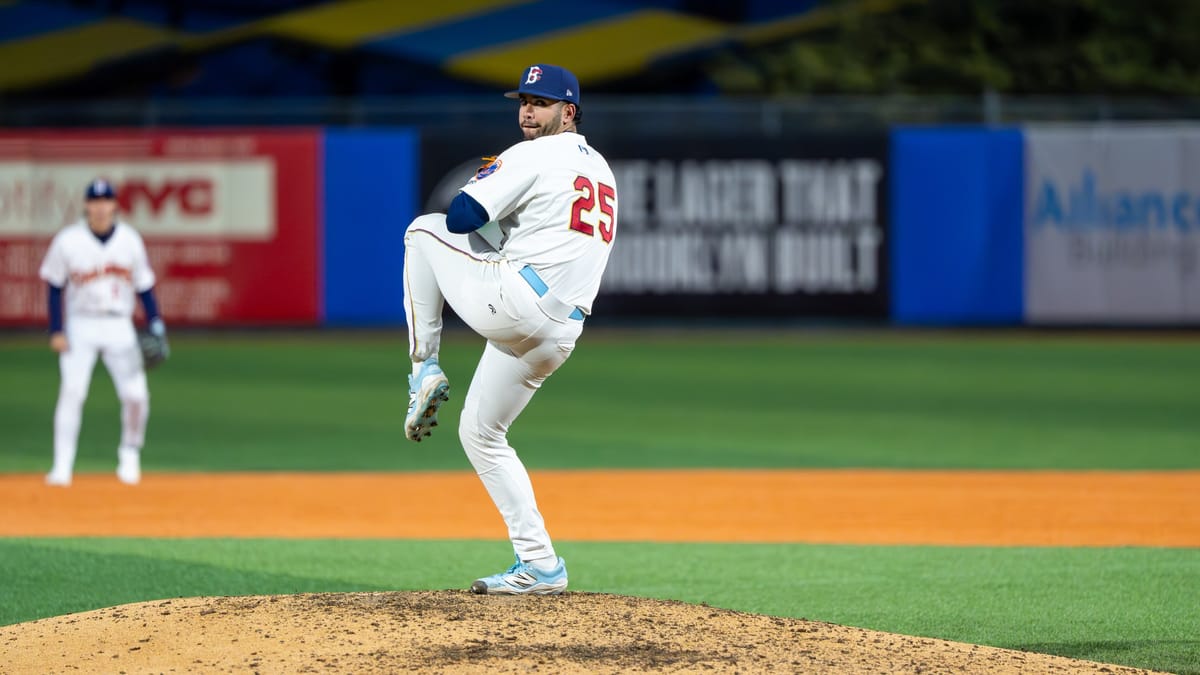
As we head into Grapefruit League action later this week, the Orioles roster looks very deep in position players, but some questions remain about the bullpen, and even a seemingly deep rotation can get tested over the course of a season. Here are some thoughts on five pitchers to watch in camp, based on a combination of arm talent and proximity to the show.
Anthony Nuñez
Originally drafted by the Padres as an infielder in 2019 and released in 2021, Nuñez took advantage of an NCAA rule exemption to play college ball with Division II Tampa, first as a third baseman before converting to the mound in his final season in 2024. The Mets signed him in June of that year and his rapid acclimation to pitching saw him shoot up to AA by mid-2025. The Orioles acquired him as one-third of the return for Cedric Mullins at the deadline, and he has quickly become one of the most intriguing relief arms in the system. Below is a snapshot of his 16 relief appearances for AAA Norfolk.
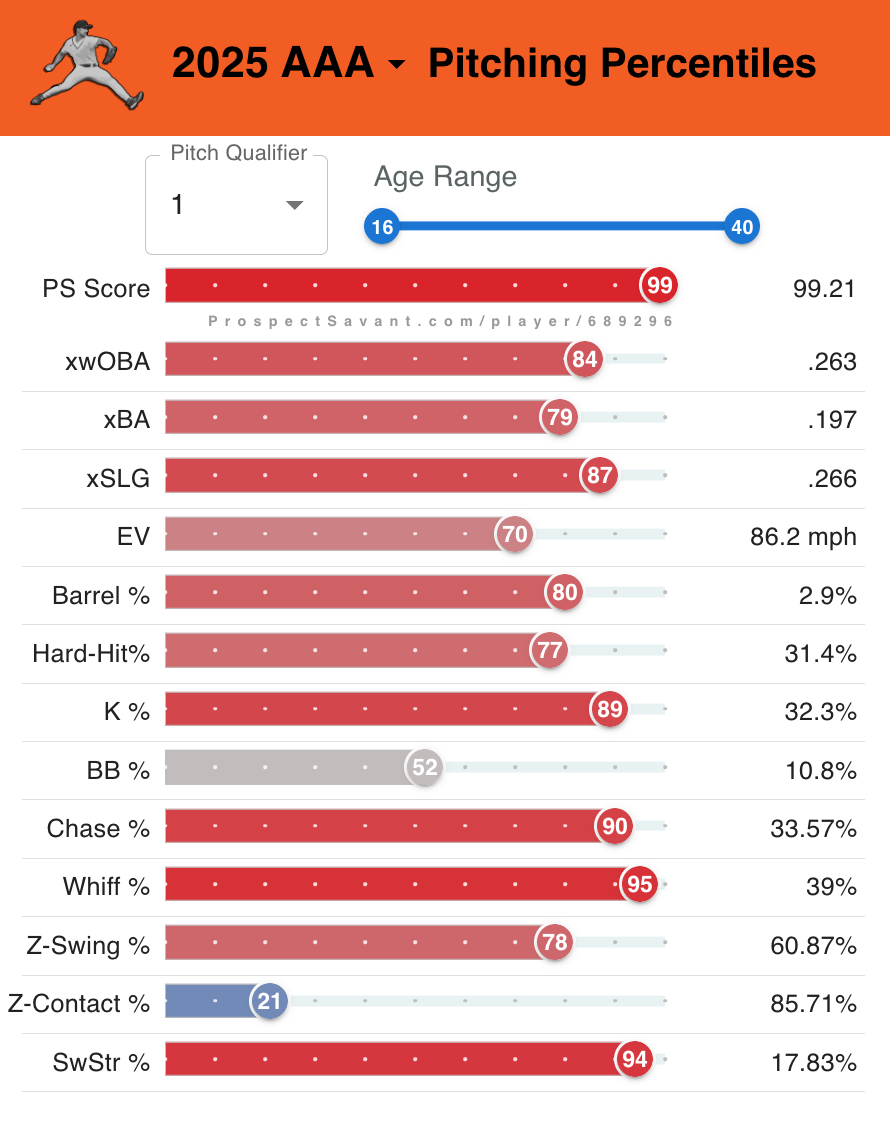
All told, Nuñez put up a 2.06 ERA with a 2.38 FIP across three levels in two organizations last year. The stuff backs up the performance. Nuñez utilizes a 5-pitch mix — remarkably robust for a second-year pitching convert — consisting of a 96 MPH four seam fastball, hard cutter, wipeout slider, plus changeup and usable sinker. He relies on the cutter as his primary pitch, as it tunnels well with his whiff-inducing slider, but he can miss bats up in the zone with the fastball and later in counts with the changeup as well.
Nuñez is my sleeper candidate to make the pen out of spring training. He's still a little rough around the edges mechanically and has room to improve his command, but he's on the 40-man roster and will turn heads in Grapefruit League play. His deep arsenal could also play as a starter, but given his below average command/control and the lack of innings under his belt, it'd be a 2+ year project. I expect him to see innings out of the Orioles pen this year, maybe soon, and he should settle into a medium-to-high leverage role eventually.
Trey Gibson
Gibson is, by many accounts, the top Orioles pitching prospect, appearing on Top 100 lists from Baseball America, FanGraphs, ESPN and more. The 23-year-old RHP relies a pair of 94-MPH fastballs (4S/2S), a pair of plus sliders (gyro/sweeper), a plus curveball, a developing cutter and an underutilized changeup. It is a deep and high-quality arsenal that, combined with average command/control, makes him a fairly high-probability starter with mid-rotation upside who should debut later this year and become a fixture in the Orioles rotation.
Now that Statcast data is available in all Grapefruit League stadiums, the big reason to watch Gibson is to keep an eye on his fastball shape. While most reports and limited lower-level data had Gibson with more than 17 inches of induced vertical break on his mid-90s four seam, it was down to just over 15 inches of IVB with modest spin rates after his late-season promotion to AAA Norfolk. There are two potential explanations: he was gassed after surpassing his previous high in innings, and he had trouble adjusting to the AAA ball, which has lower, flatter seams, making it harder to generate backspin and magnus force through air resistance. Some pitchers also complain that the ball is slicker, making it harder to grip and spin.
Unfortunately, the AAA ball is the same as the MLB ball, so he'll need to make an adjustment if that's the issue. There's plenty of precedent for that, but you need to see it to believe it, so I'll be tracking Gibson's fastballs closely this year. His sinker can mitigate some loss in effectiveness, but the ceiling lowers if he's not able to induce whiffs with a good four seam and use it to set up his plus secondaries.
Luis De León
If Gibson is the most common pick for top Orioles pitching prospect, Luis De León is right behind him.
Signed as an amateur out of the Dominican in 2021 for a mere $30,000, De León has been a developmental success story for the Orioles, improving the command of his 70-grade fastball in 2025 as his slider and changeup became more effective as well. The 22-year-old finished strong at Hi-A, dominated in 3 starts after a promotion to AA Chesapeake and continued to impress in the Arizona Fall League. Just take a look at the AFL pitching percentiles below.
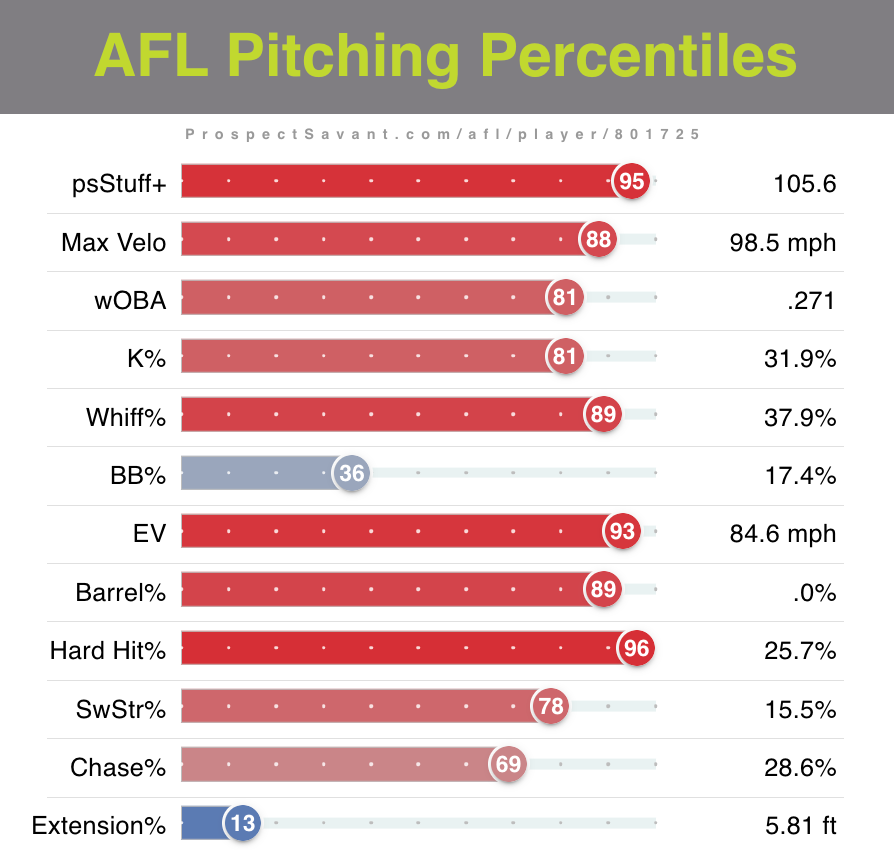
Once seen as a raw arm with good velocity but poor control, LDL is now a reasonable strike-thrower with an arsenal of plus pitches that work against righties and lefties alike. He'll start back at AA, but could earn a promotion to Norfolk in short order and be banging on the door to Baltimore in the second half. That said, one of his developmental goals should be to build an innings platform that can vault him into the Opening Day rotation in 2027. An elbow issue last year limited him to 87.1 regular-season innings, though he hit 103.2 IP with the AFL included.
Levi Wells
Wells is less heralded than Gibson and LDL, but he is an intriguing arm who could stick in the back of a rotation with further refinement or, more likely, be a weapon out of the bullpen.
His fastball sits around 96 MPH, but it can touch triple digits and has ticked up significantly in recent years. Unfortunately, he has trouble maintaining that velocity effectively deep into games. The 16.8 inches of IVB is modest, but it plays up thanks to a fairly flat vertical approach angle. He tends to rely on a slider/sweeper combo as primary weapons against righties with a curveball against lefties and a cutter that plays against both hands. He has mostly ditched his changeup, but he might need it to stick in the rotation.
On that note, while I expect the Orioles to continue to develop Wells as a starter in Norfolk this year, he probably lacks the mechanical consistency and stamina to maximize his potential there. He profiles better as a reliever who can condense his arsenal and rely more heavily on his plus fastball, which plays up in short stints. Look for him to be late-season relief option for the Orioles this year.
Nestor German
German, 23, is another AAA arm who could debut before the end of the season. He combines a riding fastball that boasts nearly 20 inches of induced vertical break with a plus, whiff-generating splitter, mixing in a tight slider and curve that both flash above average.
The downside is that, despite the rising action on his fastball, his extremely over the top delivery and high release point create a steep vertical approach angle, meaning he'll need to locate that fastball at the top of the zone to be effective and miss bats. The steep angle will render any fastball that comes in under the letters quite hittable, especially sitting at 92-93 miles per hour. That angle will also lead to a lot of fly balls, making him susceptible to the long ball. Not surprisingly, after 24 solid appearances across Hi-A and AA, German's fastball got torched for a .640 xwOBA in a couple of AAA appearances at the end of the season.
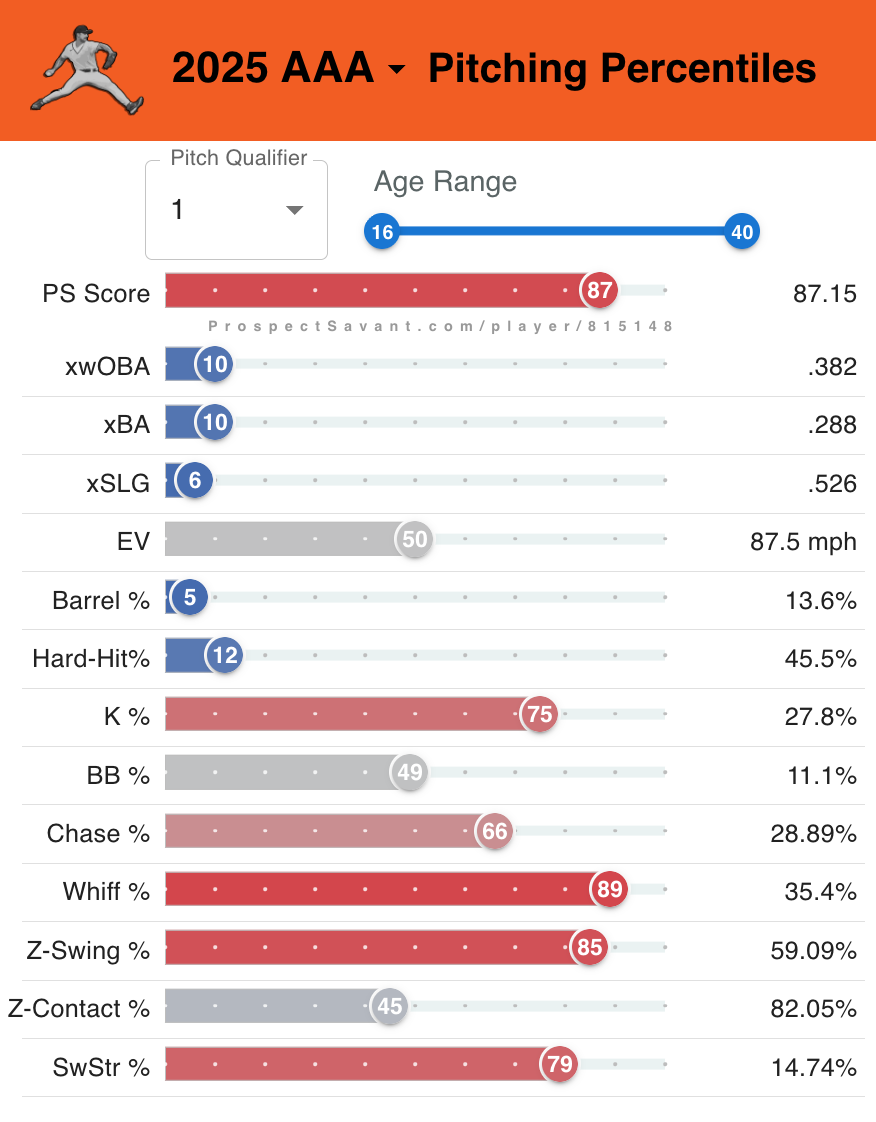
Despite the rough welcome in Norfolk, German does have the frame and arsenal to stick as a #4 or 5 starter if he can improve his fastball locations and/or gain a tick or two of velocity. And he misses enough bats with his secondaries that he can use the four seam as a setup pitch without over-relying on it. There's solid reliever floor there if he can't stick as a starter.