Mailbag: Bullpen, J-Daniel, Draft
We're two weeks into Spring Training, so it's time for a mailbag. Also, gyros.
We're two weeks into Spring Training, so it's time for a mailbag. I asked you to ask, and you answered by asking. Let's get into it.
Lucy asks:
What’s an out-of-left-field bullpen move you would make (trade or signing) to give us more support?
Eric asks:
Predict which bullpen arms make the team opening day *and* are still on the active roster August 1.
I'm going to take these two together, in a roundabout way. My issue with the bullpen as currently constructed is that there aren't many (one?) proven, high-leverage arms, and the guys who fill out the rest of the ML depth chart are old or unproven or changing roles or coming off poor seasons. Behold.
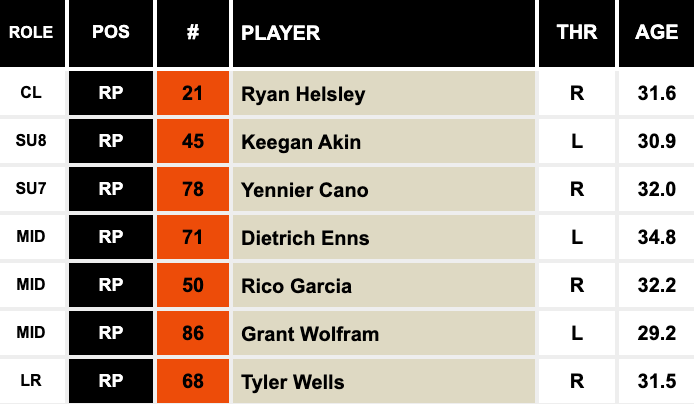
That said, relievers are notoriously volatile, and spending big on the middle of the free agent market is generally not a good bet. If you're going to spend, it's wise to look for guys with great stuff and a history of great performance in high-leverage situations who are coming off down years without much concern under the surface. Enter: Ryan Helsley. Great signing. Should rebound to be a solid closer.
Everyone else on this list could be anywhere from a solid setup arm to a mid-season DFA. But that's the reality of most relief arms. Would I feel better with a JoJo Romero or a Danny Coulombe instead of one of the lefties on this list? Sure. But if we're being real, the weighted projections of the names on this list and the guys who'd cost $5-8M in free agency overlap quite a bit, so the upgrade is probably minimal.
Which brings me to what I do like about the pen: the guys who are not on this list. Move a little down the 40-man roster and you'll find Anthony Nuñez, Chayce McDermott and Cameron Foster, all guys with very good stuff and high-leverage upside who I expect to see Baltimore this year. You'll also find Grant Wolfram, who might not be able to get righties out but has the kind of arsenal and arm angle that can humiliate lefties. There's also Cade Povich, who could thrive in the pen if they choose to put him there. In short — like the rotation — it's a group that is light on marquee talent but deep in useful and interesting arms.
To Lucy: while I'm not in love with this group, I'm not sure I'd go crazy to get someone like JoJo Romero, but I'd like to add someone in that vein. My actual out-of-left-field plan might be to let one or two of these model-friendly minor league arms make the club and take advantage of the flexibility that options provide. If that feels like a cop-out, how about making a play for one of the Rockies' high-octane arms (Vodnik, Mejia, Halvorson).
To Eric: While I'm sure a few will qualify, I'm not really confident in any of the likely relievers beyond Helsley to be both healthy and consistent enough to make the opening day bullpen and remain on the active roster past the deadline. But I will make a bold, if hedged, prediction: If Anthony Nuñez shows well enough in camp to make the opening day roster, he won't be sent back down.
BlueSky user jdub3000 asks:
What might a reasonable Rogers extension based on a potential QO at the end of the season look like?
After a disappointing first impression following the 2024 trade deadline, Trevor J-Daniel Rogers was a revelation last year, posting a minuscule 1.81 ERA, a more believable but still excellent 2.82 FIP, and 3.3 fWAR over 18 starts and 109.2 innings. xERA, xFIP and SIERA all had him in the mid-3s, but it was clearly a stellar — if abbreviated — season for Rogers, who started the season on the IL with a dislocated right knee but went on to pitch 132.1 innings between levels.
Fans have been beating the drum for an extension. While Rogers himself has said he'd be open to it, he also said he's not aware of any formal discussions between the team and his agent. That doesn't mean they haven't happened, or that they won't as spring goes on, but he's a bit of a tricky case. He hasn't been durable or consistent enough (nor does he possess the high-end stuff) to get a Crochet-like mega deal. That said, his 2025 was a return in some ways to the top-of-the-rotation potential he showed back in 2021.
I'm going to suggest two fairly recent comps here: Jack Flaherty (2025) and Carlos Rodon (2022). These are pitchers who had star-level breakouts early in their careers, spent several years injured or ineffective, then had stronger platform seasons before signing these deals at age 29.
Flaherty entered free agency for the second time in 2025 off a strong season with the Tigers (162 IP, 3.17 ERA, 3.3 fWAR) — a solid bookend after four years of injury and/or ineffectiveness since his 2019 breakout (196.1 IP, 2.75 ERA, 4.5 fWAR). No team was willing to gamble nine figures on the notion that Flaherty would live up to his early promise as a budding ace, but he was finally healthy and things under the hood looked good. In the end, he re-upped with Detroit for what was essentially 2/45 with an opt-out, though he needed to start 15 games to hit the escalator.
Rodon, like Flaherty, appeared to be on a top-of-the-rotation trajectory at age 23 before spending four years plagued by injury and inconsistency, ultimately breaking back out at age 28. Rodon's rebound season was even more impressive: a 2.37 ERA backed by a 2.65 FIP with an elite 34.6 K% and 5 fWAR over 132.2 innings. Rodon's rate stats were some of the best in baseball that year, but because he'd only made 24 starts after many years of failing to put it all together, he could only leverage that into a two year, $44 million deal with the Giants, with an opt-out that he promptly exercised after a full season of dominance.
Trevor Rogers' trajectory has been remarkably similar to those of Flaherty and Rodon, only he spent one fewer year foundering and bounced back a year before free agency. He now has the choice between capitalizing early to attain some pre-FA stability or betting on himself to max out his earning power next year. If he believes in his ability to stay healthy and repeat, why would he pre-empt a potential 9-figure deal next winter for a more modest guarantee now?
Well, Rogers is only a year or two removed from questioning whether his time as a pitcher was coming to an end. It's been a tumultuous journey for the left-hander, and while his confidence must be sky high, you could still understand the appeal of locking in tens of millions of dollars right now instead of risking further injury. He's not going to give up a chance at a huge payday. Any deal he signs now would have to grant him the ability to hit free agency at a young enough age to secure an even bigger contract.
Because of Rogers' leverage, I think the Orioles would need to guarantee more than what Flaherty and Rodon received, though a similar AAV of $22-24 million feels right. Let's say 3 years, $72 million or 4 years, $88 million, starting in 2027, with an opt-out after two years in either case. He'd lock in a sizable guarantee if his career takes another hit, but give himself the ability to hit free agency after his age 30 season if he continues his success. It makes sense to me, but only Rogers and his agent know what he values most.
DL asks:
Who do you want at 7 in the draft?
It's early and I'll have post more draft thoughts here in the coming months, but for now I'll highlight three guys I'd consider at 7th overall. I'm going to ignore the consensus top two names — Roch Cholowsky and Grady Emerson — and also assume that Jacob Lombard, Jackson Flora and Justin Lebron will be off the board, though any of those five would be excellent targets should one fall. Let's do a college pitcher, a college bat and a high school bat.
Cameron Flukey | RHP | Ht: 6'6" | Wt: 205 | School: Coastal Carolina
Flukey is a tall, lean righty with big-game experience for Coastal Carolina and a competitive drive on the mound. He sits in the mid-90s and touches 98 with good life on his fastball, generating plenty of whiffs at the top of the zone and pairing it with a plus curveball that gets chases below it. His high three-quarters slot gives his curveball great shape but makes it hard to throw for strikes, and the higher release point makes his fastball more hittable when it enters the middle-to-bottom of the zone. He also shows an above average gyro slider and an in-progress changeup. He has the frame to start if he can improve his command, and he has mid-rotation upside if he can find a changeup that works.
Baseball America ranks him as the top starter in the class, though some think his arm slot will make him hittable when he's not locating. I'm including him as an option at 1:7 because a recent stress fracture in his rib is going to keep him out at least six weeks and might keep him from going in the Top 5. It's possible he could fall much further if he has trouble returning.
Drew Burress | OF | Ht: 5'9" | Wt: 175 | B-T: R-R | School: Georgia Tech
There's a chance Burress might be off the board by the time the Orioles pick, but he's ranked in the 5-10 range on enough national lists right now that I'm considering him fair game. And I really like him. He's one of the best overall hitters in the draft who has shown he can handle velocity and spin with a strong combo of contact, damage and swing decisions. The one issue is that his listed 5'9" height might actually be a stretch, and there's no projectability left in his frame. But even if he's maxed out, he's a complete hitter now with plus raw power and great instincts at the plate. He's not a burner but does run well enough that many scouts think he can handle center field. If he has to slide to a corner, his size becomes more of a concern and the in-game power bar becomes higher, but he has the arm to handle right and he's well-rounded enough to profile as a regular at any outfield spot.
The conundrum for the Orioles is that if Burress has a strong season, he could be off the board by the time they pick. If he's there, it's because some combination of size and range caused him to slip just a bit. But he's a reasonable target here and should move through the system quickly as an advanced hitter.
Tyler Spangler | SS | Ht: 6'3" | Wt: 195 | B-T: L-R
Since Spangler is a tall, left-handed shortstop and a standout hitter in the high school class, the comparisons to Gunnar Henderson and Kyle Seager are inevitable. Spangler doesn't quite have the same physicality and explosiveness, but he's got a ton of projectability left in his frame and better bat control than Henderson at the same age, leaving open the possibility that he could grow into a similar bat-forward shortstop who is less of a swing project and really just a projection bet. He's a little more upright with a slightly more narrow stance, and there's an opportunity to tap into more power if he can better utilize his lower half while maintaining his bat-to-ball skills.
He's an average-to-above average runner now, so depending on how he fills out he may have to move over to third, but he's agile and athletic with fluid actions and enough arm for either spot. He has the kind of size, power, defensive abilities and offensive ceiling that the Orioles tend to look for in the draft. If they're open to a high school hitter, Spangler could be a perfect fit.
OK, that's it for this week, but feel free to leave your questions, complaints and non sequiturs in the comments below and I'll respond if I feel like it (just kidding I will try to respond to everything thank you).