Orioles Review: 3/30/26 (A good start)
The Baltimore Orioles won some baseball games again.

Weekly Review: ⚾️ ⚾️ ⚾️ ⚾️ (4/5)
Win-Loss Record: 2-1
Projected wins*: 82.9
Playoff odds*: 46.4%
*Per FanGraphs
We're so back. I'd like to believe this is the beginning of a new-and-improved era of baseball in Birdland, but I have to admit we saw some sloppy defense and poor situational hitting that was all-too reminiscent of 2025. But they won the series, something they failed to do until their sixth series last year. I'm going to try to send out this weekly review every Monday, going behind the surface-level stats to take the pulse of the big league team (and some prospects) on a regular basis. We'll take a look under the hood at some of this weekend's performances in a minute, but let's start by breaking down a big piece of off-the-field news.
Baz extension
The Orioles doubled down on Shane Baz, for whom they sent four decent prospects and a draft pick to the Rays this winter, by signing him to a 5-year, $68 million extension. The deal commits $22 million total to his final three years of control and buys out two years of free agency at $21 million in 2029 and $25 million in 2030, keeping Baz in Baltimore through age 31.
While Baz may not have seemed like the first starter to be extended — Trevor Rogers will be a free agent after this season and Kyle Bradish is home-grown and longer tenured — he is in many ways a perfect fit: young enough that they're buying out close-to-peak years, unproven enough that he was willing to take the guaranteed cash, and with good enough stuff that you can dream about him becoming a top-of-the-rotation arm.
Orioles fans got glimpses of all of that in his start on Sunday, in which he went 5.1 innings, allowing 4 runs on 7 hits with no walks and 4 strikeouts. This graphic from Pitcher List pretty much tells the story:

Ace-level stuff, mediocre locations and some bad batted ball luck (and, erm, questionable defense) that led to worse results than you'd expect. The damage was all confined to the second inning, and he looked great otherwise. Still, this investment is a bet that the stuff will carry him, and that the Orioles can improve the command and consistency. The good news is that he's fully healthy, having made 46 consecutive starts dating back to mid-2024, and his stuff now looks closer to what it was pre-elbow injury than post.
The one exception is the slider, which used to be an effective weapon against righties but has disappeared from his arsenal completely. In Spring Training we saw him manipulate his cutter to achieve a distinct bullet slider shape at times, but I saw less variance in Sunday's start. Something to watch. Even if Baz remains a promising but inconsistent arm, the kind who flashes greatness but winds up as a 4.25 ERA, #3/4 starter, this is still a fine investment. If he comes close to approaching his ceiling, it'll be a steal.
Let's take a look at some other performances from Opening Weekend.
Trevor Rogers got things started with an effective-if-shaky debut: 7 IP, 3 H, 0 ER, 4 BB, 5 K. The adrenaline must have been pumping as he came out sitting 95 MPH and touching 96, but he settled in at 92-93 the rest of the way. Fatigue may have also contributed to some command issues, as suggested by the four walks and a 38% zone rate on his fastball. Ultimately, he kept runs off the board like he did all last year thanks to some big pitches and help from his defense, including three double plays turned. A couple of his pitches have been reclassified at his nudging: His slider is now a "cutter" and his sweeper is now a "curve." OK.
Kyle Bradish was mostly effective on Saturday despite spotty command (are we sensing a theme yet?), walking 3 over 4.2 IP with 4 strikeouts and a home run allowed. One thing to watch with Bradish is how he's holding velocity as the game goes on. He sat 94.5 on his sinker in the first two innings, hitting 95.4 in the first, before dropping to 93.1 by the fourth and 91.8 before getting pulled in the fifth. He fell from 95 to 91 over the course of his final Spring Training start as well. It may be nothing, but Bradish hasn't pitched much in the last two years, so it's worth keeping an eye on how he handles a starter's workload as the season goes on.
Ryan Helsley HOLY SHIT. I am no stranger to the fact that Helsley's stuff is nasty. I've seen it as a dispassionate observer. But watching him throw 102 MPH fastballs with more than 20 inches of vertical break in an Orioles uniform is something else. And it's just a tiny sample, but his slider is quite literally breaking the Stuff+ scale.

Helsley converted his first two save opportunities with relatively little drama and a whole lot of heat. He looks fully over whatever was going on with him after the trade to the Mets last year, and if he can maintain this kind of stuff it's going to be very fun to watch him close out games. They just need to figure out who gets high-leverage innings before the 9th. Which brings me to ...
My guy, Anthony Nuñez. He's not quite Helsley, but he's not that far off, and the arsenal is deeper. If you think Helsley's Stuff+ chart was fun, check this out:

I've been bullish on Nuñez all spring, so I was pretty pumped to see him make the Opening Day roster and even more excited to see him hit the ground running. This is really special stuff, and he's my easy choice for primary setup option this year. He has the pitch foundation to start, but not the innings foundation (and maybe not the command). They'll let him eat out of the pen for now and reassess next winter. Either way, I think we'll be seeing him in Baltimore for a while.
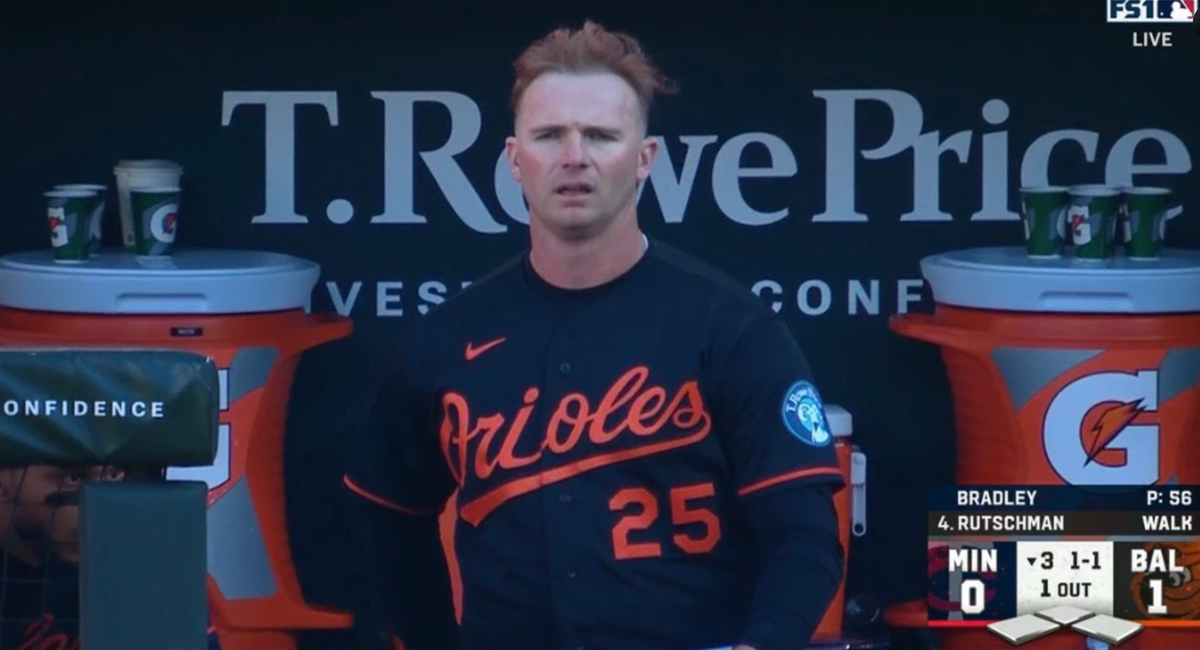
Adley Rutschman looks like vintage Adley Rutschman. He went 3-for-7 over the series with a pair of doubles, a pair of walks and just one strikeout. He's being a little more aggressive in the zone without striking out, and his average bat speed is up about 2 MPH from his career averages. It's as early as early can be, but this is a very good sign.

Coby Mayo went hitless in the first two games before breaking out Sunday with a doink double and an RBI single (adding a 105-MPH groundout as well). He's walked twice and struck out twice in his first 11 plate appearances, carrying over the improvements in plate discipline and contact that we saw in camp. But the crucial part here is his defense: Not only has he avoided mishaps and made the routine plays at third, he's made multiple gems as well, including a few impressive double plays. He looks confident, and if he can continue to hold down third base it'll make Jordan Westburg's absence hurt much less.
Tyler O'Neill is off to a strong start at the plate despite lackluster defense, going 2-for-7 with a pair of walks. One of those two hits was a huge 3-run home run on Sunday. Sure, he was making up for an earlier defensive miscue, but dingers. He's hitting the ball hard as usual, and I'd be shocked if he came anywhere close to the massive delta between his .297 wOBA and .360 xwOBA from last year.
Outside of standout performances from Helsley and Nuñez and yet another bases-loaded Houdini act from Rico Garcia, the pen looked unsurprisingly suspect. And other than Coby Mayo inexplicably looking like a Gold Glover over a weekend of play at third, the defense was sloppy as well. Those are glaring weaknesses for the team and bear monitoring in the weeks ahead.
On the farm
Trey Gibson was wild in the Tides opener, walking 5 with a 41% zone rate on his sinker. He went 3+ innings and allowed 3 runs on 6 hits to go along with the walks, but he did strike out 4 with 9 whiffs on 28 swings. While his command was awful his sinker looked good, topping out at 97.4 in the first inning and averaging 93.1 He looked gassed as the game went on, but it's an improvement over his 91.9 mark this spring.
Nestor German followed for the Tides on Saturday and was solid, going 5 IP with 2 ER, 1 BB and 5 K. His fastball velocity, as usual, was modest at 91.7 (topping at 94.9) but he averaged an impressive 19 inches of IVB. He got 6 whiffs on 28 swings, including a 43% whiff rate on the splitter. His walk rate bloated in his brief AAA debut last year, so one walk in five innings was nice to see. But his 41% zone rate (47% on the fastball) still needs improvement. Here's his pitch report from Savant.

Levi Wells started shaky but finished strong, allowing 1 run on 2 hits with 2 walks and 6 strikeouts over 4 innings. His fastball sat just over 96 and hit 99 with some ride. I love the stuff, but I'm not sure he has the command or durability to start in the big leagues. He has been unable to (or the club has been unwilling to let him) go deep into games, averaging about 3.5 innings per game as a pro. But he does seem to hold his velocity well, so I'm not completely ruling it out. Ultimately that arm has some kind of future on an MLB staff.
Jackson Holliday began his rehab assignment from hamate surgery at Norfolk, going hitless in 6 ABs with 4 strikeouts and 1 walk. That obviously doesn't look good, but there's not much to take away from this other than he's healthy enough to be in the lineup and he's at the beginning of a rehab assignment after a long winter with no Spring Training. Holliday is hoping it'll be a quick assignment, but he could be down there until mid-to-late April if he needs more time to shake off the rust.
Creed Willems went 4-for-10 with a pair of walks, splitting time between catcher and first base. If it weren't for Holliday, the 22-year-old Willems would be the youngest player on the Tides roster. His age, level and decent offensive ceiling makes him one to watch at Norfolk, though his ultimate position is a question mark. He probably won't ever be able to handle catcher on more than a back-up basis, if at all. And although he should be a competent big-league bat, I'm not convinced he'll hit enough to be a regular 1B/DH.
Enrique Bradfield, Jr. went 3-for-9 with 3 singles and a walk, perfectly cromulent. And he doesn't need to be better than that to be very valuable as a big leaguer. But questions remain about whether his bat speed and exit velocity will play at the next level. All he can do for now is continue to find his way on base and use his wheels and glove to impact the game. As the weeks go on, I'll be watching to see if he can lift the ball with any authority and put up respectable ABs against left-handed pitching.
I want to shout out my fellow Orioles supporter Conor McGovern for building a very cool tool called Dynasty Index, which allows you to follow minor leaguers and track their progress in a number of categories, including metrics from Statcast data. I've been testing it for a bit and it's a great and very useful passion project. I'll be using it to track a lot of the Orioles prospects I cover in this newsletter.
We're coming back
I caught the legendary '70s English punk/Oi! band Cock Sparrer in Brooklyn on Saturday, along with (much younger) New York locals Disket and Beton Arme from Montreal. The lyrics can be a mixed bag, but Cock Sparrer's catchy songs have been stuck in my head for about 25 years now, and it was great to see the tossers live.
Please feel free to jump in the comments. I'll reply. See you next week.