Orioles Review: 4/6/26 (frustratingly familiar)
It can't all happen again, can it?

Weekly Review: ⚾️ (1 out of 5 Bassitts)
Win-Loss Record: 1-5 (3-6 total)
Projected wins*: 81.7
Playoff odds*: 39.2%
*Per FanGraphs
Sloppy defense, poor situational hitting, late leads blown, old starting pitchers playing out the messy ends of their careers. You'd be forgiven for thinking it's 2025. In a very short sample, the Orioles don't seem to be righting what went wrong last year. But I have to emphasize just how early it is, which means there's plenty of time to turn it around, and that some of the results are noisy. Let's take a closer look at what's actually going on.
After Sunday's game, the Orioles stand at a pitiful 24th in ERA (4.71), but they're tied for ninth in xERA (3.52). We've obviously seen a few bad pitching performances, but on the whole the results aren't reflective of the underlying talent or process. On the offensive side of things, the team is 14th in wOBA (.313) but 10th in xwOBA (.323). Defensively, the they're 22nd in FRV (-2) and 26th in FanGraphs defensive value (-2.7). It's an especially small sample to find meaning in defensive metrics, but you can rely on the eye test to tell you it's an area in need of improvement.
If you under the hood, you'll see bad defense, mostly decent pitching and above average hitting. That's more or less in line with how this team was seen coming into the season. But a lack of fundamentals is rearing its head again, and a good team has lost more games than it should have in its first few series. Fans have every right to be frustrated with the state of play. But it's also true that there are 153 games remaining. Today I'm going to look a little closer at starting pitching up and down the org.
Unfortunately, we need to start with Zach Eflin. Damn it. Following successful surgery to fix a recurring back issue that has long hampered his durability and was a key factor in his poor results last year, Eflin looked totally renewed. The stuff was as good as ever this spring and the locations were sharp enough that he forced himself into the Opening Day rotation, bumping Dean Kremer to Norfolk. He racked up 7 strikeouts in 3.2 innings in his debut before a two-out walk to Evan Carter prompted an extended mound visit. He threw one more pitch before athletic trainer Scott Barringer ran out to the mound with manager Craig Albernaz right behind him. He exited with what we later learned was elbow discomfort, and is now seeking the dreaded "second opinion" from Dr. Keith Meister. Brutal. Absent a miraculous new reading of his scans, it's safe to assume Eflin will be out for some time, possibly the remainder of the season if surgery is necessary. The Orioles will probably have to carry on without him.
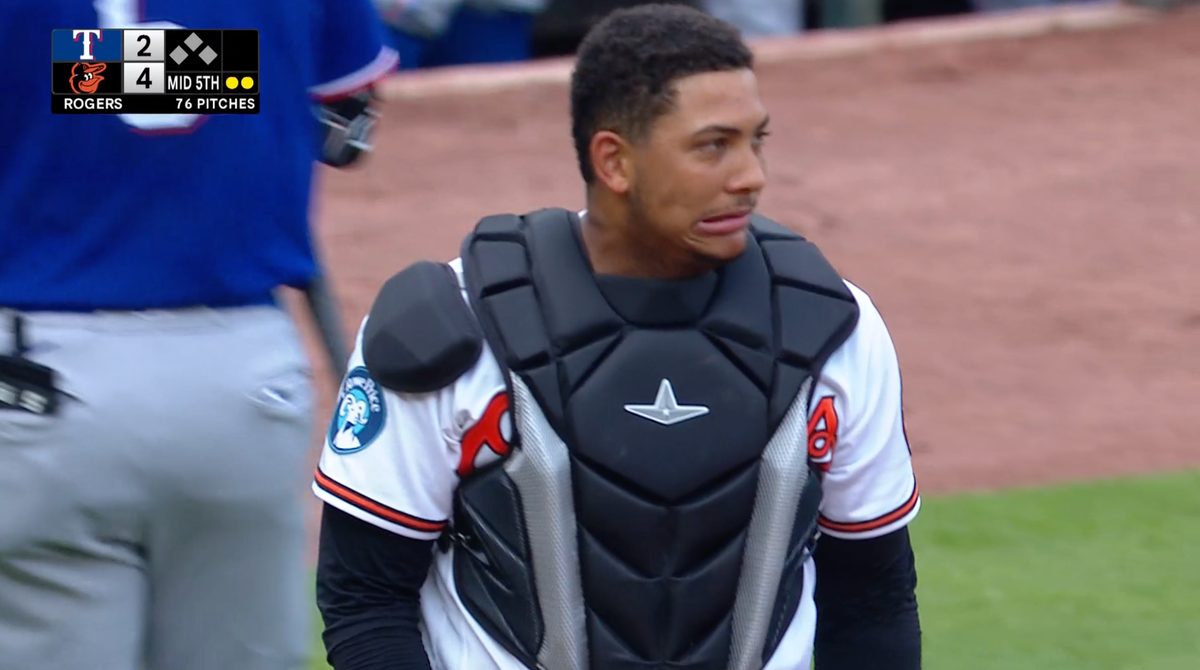
Trevor Rogers looked good again Wednesday, getting BABIP'd a bit in a 2-run 4th inning but otherwise cruising: 6 IP, 6 H, 2 ER, 1 BB, 3 K. His fastball velocity was down a little from his first start but still around 93. His stuff is consistently mediocre, but he just keeps eating up innings and keeping runs to a minimum with command and deception. He now has a 1.76 ERA over 20 starts and 122.2 IP dating back to the start of 2025. Peripherals and pitch models suggest more of a mid-3 ERA "true talent" pitcher, but his run prevention over that span is special.
Kyle Bradish is still the most important arm in the rotation. His second start was mixed again, as he allowed 4 runs in 4 innings with 6 strikeouts but 3 walks. The stuff is close to where it was in 2023, but his command has been quite bad —specifically his fastball command, with a Location+ of 71 on the sinker. He has also had trouble maintaining velocity, dropping about 3 MPH off his fastball after the first couple of innings in three straight starts dating back to his final spring appearance. The poor fastball command and leaking velocity could just be a sign of arm fatigue as he tries to ramp up after pitching so little over the last 2.5 years. It could also be a sign of something structural, but let's not even allow ourselves to go there yet. Whatever the case, the difference between a healthy, prime Kyle Bradish and an injured or ineffective one could be all the difference for the Orioles' playoff hopes.
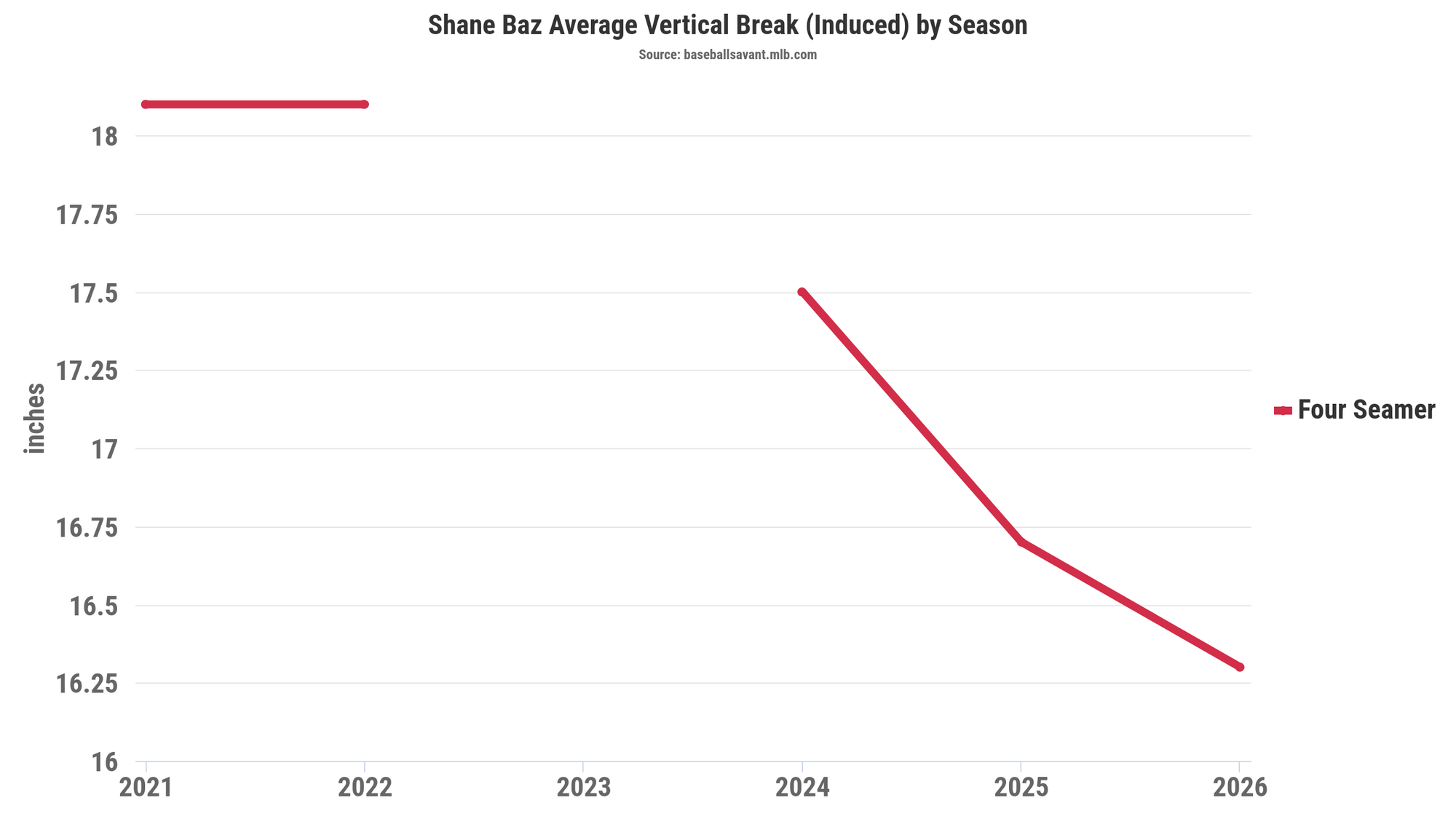
Enter: Shane Baz, the Oriole starter with the best stuff and highest ceiling. Through two starts, Baz is showing glimpses of that ceiling along with some clear developmental needs. The ERA-ish stats look good: 3.27 ERA, 3.27 xERA, 2.93 FIP and a less rosy 4.56 xFIP (driven by a lot of fly balls with no home runs yet allowed). Baz's 103 Stuff+ is slightly down from last year's, though other models show him at parity or slightly better. His 97.2 MPH fastball velocity is as good as it's ever been, though he has lost a couple inches of ride from his early-career peak. He gets a pretty good combo of chases and whiffs with it, but it's worth watching how he balances velocity and ride.
The knuckle curve is his out pitch, and he's actually throwing it a little more than the fastball this year. It models pretty well but isn't quite getting the whiff% I'd expect and sometimes gets teed up, likely due to the reduced depth he's getting this year. He continues to improve the cutter he debuted last year and has shown the ability to manipulate the shape and velocity to get a slider-ish effect at times, which helps compensate for the fact that his slider appears to be gone forever. He mixes in a change and sinker, which don't look great but are crucial to add some armside run to his arsenal.
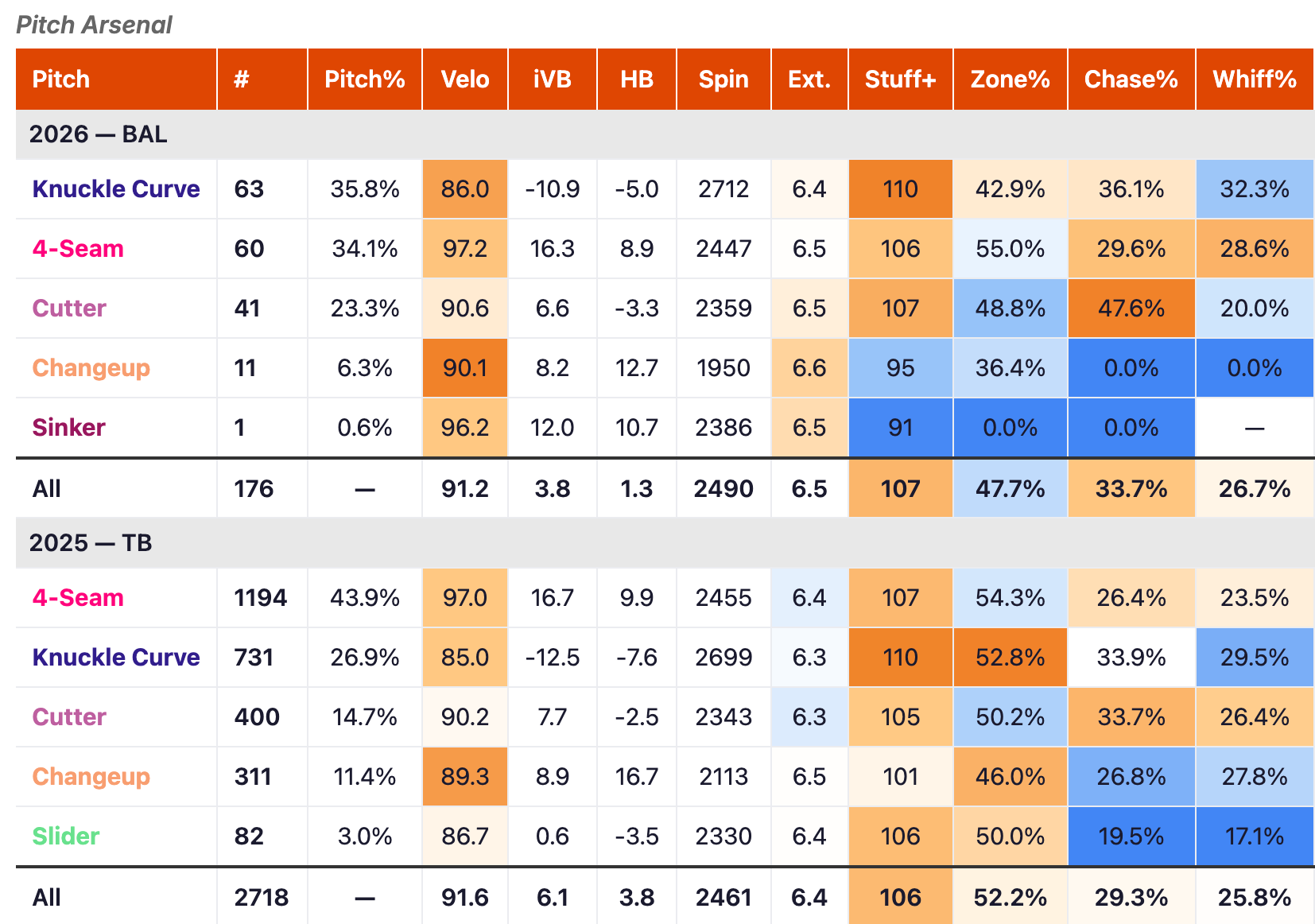
Overall it's a well above average 5-and-a-half-pitch mix, but his command (89 Location+) continues to be an issue. In fact, he hasn't thrown a single pitch with above average locations this year, despite a big improvement in that area in 2025. Assuming he can shore that up, he still has top-of-the-rotation upside. Sharper command, especially of his primary fastball/knuckle curve combo, will hopefully lead to a better strikeout rate.
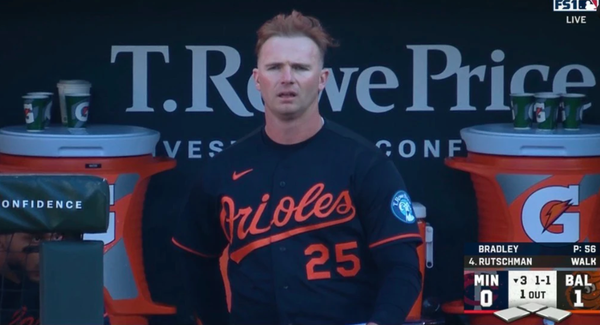
Chris Bassitt has gotten off to a disastrous start. The veteran was brought in to keep the bottom of the rotation from falling out, but he has caused my bottom to fall out in each of his first two turns. His debut against Texas wasn't actually as bad as the results (4.1 IP, 4 ER) suggest. His velocity and shapes were almost unchanged from 2025, when he threw 170.1 innings with a 3.95 ERA. But he showed uncharacteristically poor control, walking 4 batters and getting hit hard on a handful of meatballs. Sunday against Pittsburgh was another story. With the Orioles in need of a stopper to prevent an early-season sweep, Bassitt crapped the bed, lasting just 2 innings and exiting with 6 runs allowed on 6 hits, a pair of walks and 2 hit batters. His velocity was only down a bit, though when you're starting at just 92, every fraction of a mile per hour matters. But the bigger culprit, again, was command. Underneath the walks and HBPs was a bad 52% strike rate and a worse 39% zone rate. Bassitt simply doesn't have the stuff to survive with that kind of command. It's not as alarming as stuff collapse, but you might remember that Charlie Morton's issue last year was command, not velocity or stuff, and command also has an aging curve. Bassitt will probably rebound, but he might not, and the Orioles need to decide just how long a leash to give him.
Cade Povich followed Bassitt with a much needed 5.2 innings of relief, allowing 2 runs on 4 hits and 3 walks with 2 strikeouts. He was effective when locating his fastball, which had a nice 19 inches of ride, at the top of the zone, and then finishing with offspeed and breaking balls down. But, as is often the case, he didn't hit those spots consistently, and he's homer-prone when he isn't locating.
On the farm
Let's stick with pitching and take a look at how some notable arms have started out, in no particular order except that I'll start with the most exciting:
Joseph Dzierwa dominated in his organizational debut for Frederick on Friday: 6 IP, 1 H, 0 ER, 1 BB, 9 K. Dzierwa did not pitch professionally after being drafted in the second round last year, so we've been waiting a while for this. He pitched very well for Michigan State this year, but despite a plus changeup he fell to the second round because of modest low-90s velocity and questions over how his fastball would play in pro ball. Well, we got a glimpse of that in the Spring Breakout game, and not only was he sitting 94.5 and touching 96, the shape of his fastball actually improved with the pro ball, showing 16 inches of IVB and 17 inches of armside run. That combination of ride and run is extremely unique: The closest MLB comp is probably Cole Ragans (17/14). Statcast classifies it as a sinker, presumably because of the amount of run, but it looks more like a four-seam with elite horizontal movement. This exchange below with Raj Mehta from Prospects Live shows how the time spent in the Orioles pitching lab seems to be paying off (apologies for the impossible-to-read screenshot).
Danny Barrand (one of our scouts at Prospects Live) noted that there was potential for tweaks to his lower half, and I believe the O’s were able to establish some of those changes as his extension in his Spring Breakout outing was up by about half a foot compared to where it was at in college.
— King Raj (@rajmehta.ca) 2026-04-04T01:15:03.161Z
There was no Statcast data available for Dzierwa's start Friday, but the results speak for themselves: 9 strikeouts and 17 whiffs. This is all very encouraging, and while the sample is small, it's safe to but a big fat up arrow next to Dzierwa's name due to the development leap. Definitely a name to watch this season.
JT Quinn, the Orioles' 69th overall pick in the CB-B round last year, allowed one run over 4.2 innings in his organizational debut, striking out 6 and walking one while allowing 3 hits. That's a solid line, but the pure stuff is more impressive. Quinn's fastball sat in the mid-90s in college and was 96-98 per the broadcast on Saturday. He's also capable of getting whiffs with a pair of breaking balls, though I haven't yet seen him throw a viable changeup. He's got some deception in his delivery but has erratic command/control. We saw a bit of that Saturday, but it's workable. Another live arm in this system to watch.
Trey Gibson continues to be a mixed bag. He continued his rebound from a spring velocity dip in his second start Thursday, sitting 93-94 and topping at 95.4, but the four-seam continues to have poor shape and wasn't comfortable throwing it more than 9 times. His sinker looks better in a vacuum, but it got 0 whiffs and projects as more of a weak-contact, establishing pitch. His arsenal is deep enough and good enough to work, but he is struggling to find the right mix and his command was poor again on Thursday, with a 45% zone rate overall and just 39% on the sinker. He can't set up his good secondaries with a fastball he doesn't trust and a sinker he can't throw in the zone. That said, I'd expect the command to improve, and his cutter looks good enough to throw more (2 whiffs on 4 swings Thursday). I'm having trouble buying the #2/3 starter upside, though I still see a major league starter in there.
Esteban Mejia Mejia continued to flash the stuff that got him a brief nod on the Baseball America Top 100 list Saturday, allowing 3 runs — but just one earned thanks to some atrocious defense and a failed pickoff — on 1 hit with 6 strikeouts through 4.2 innings for the Shorebirds. That line doesn't look very special, but Mejia hit triple digits on multiple occasions and generated 15 whiffs. RidgeYaks hitters were simply unable to put good (or any) wood on his pitches. That said, he still has ways to go in the command department. His arsenal shows #2 starter upside, and even if he's still quite raw it's hard not to see a good reliever floor. He'll need to make some mechanical changes to smooth out his release point and landing.
Brandon Young had a solid season debut on Wednesday, allowing 1 run over 5 innings with 4 strikeouts and no walks for the Tides. His fastball sat 93.2 and topped at 94.7 (down half a tick), but showed typically strong ride (18" IVB) and got 4 whiffs on 8 swings. He threw the fastball for strikes (65% zone rate) ended up with a solid 67% strike rate overall.
What I'm reading
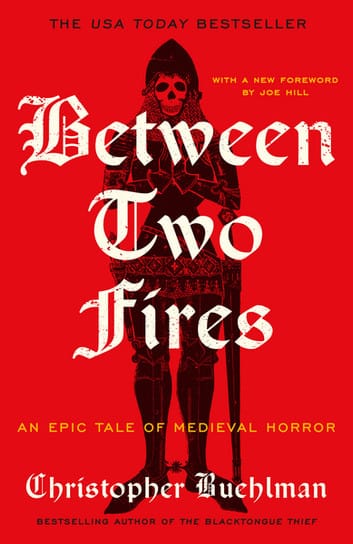
I picked up the new re-release of Christopher Buehlman's medieval horror novel Between Two Fires for a second read, and I'm loving it just as much as I did the first time. It follows a disgraced knight, a Joan of Arc-esque orphan girl and a guilt-ridden priest as they traverse plague-ridden France in the 14th century against the backdrop of a second war between the fallen angels and heaven. It's got plenty of dark fantasy, monsters, demons and the like, but a surprising amount of humanity (and even some humor). Despite many dark fantasy books with similar backdrops, I haven't found another quite like this.
Please feel free to jump in the comments. I'll reply. See you next week.